Rummy Game Library

The format ledger
Every rummy variant on the platform shares the same 13-card core. What differs is the round structure, the drop cost and the cumulative scoring. The format ledger below captures the public definitions used across the platform.
| Variant | Hand size | Drop cost | Round length | Pool limit |
|---|---|---|---|---|
| Points rummy | 13 | 25 / 50 / 80 | One deal | None |
| Pool rummy (101) | 13 | 25 / 50 / 80 | Until one player survives | 101 |
| Pool rummy (201) | 13 | 25 / 50 / 80 | Until one player survives | 201 |
| Deals rummy | 13 | 25 (or 0 in some variants) | Three deals per round | Chip-based |
| Gin rummy | 10 | None | Until a player knocks | Score to 100 |
Points rummy
Points rummy is the simplest version of the format. A single deal, a single round, and the loser pays the winner their deadwood total. It is the format most new players try first, and the format most suited to a five-minute session between two other tasks.
The drop cost matters: first drop is 25 points, middle drop is 50, and full count is 80. A first drop (before the 4th card) is the cheapest way to lose; a full count is the most expensive.

When to play points
Pick points rummy when you have a short, focused window and want a single tight decision cycle. The format teaches the basics of declaration, drop cost and table reading without the noise of a long pool arc.
Pool rummy
Pool rummy is a multi-deal format. Players are eliminated when their cumulative score exceeds the pool limit — 101 points for the beginner pool, 201 points for the advanced pool. The longer arc means a smaller per-hand swing, but a longer variance window.
A pool rummy session is closer to a chess match than to a coin flip. The middle-game judgment — when to drop, when to push, when to play the discard — matters more than the early-game hand strength.

How the pool closes
The pool closes when one player’s cumulative score is the lowest and all other players have either been eliminated (exceeded the limit) or surrendered. The session runs in cycles of deals until a single player holds the round.
Deals rummy
Deals rummy uses a fixed number of deals. Each player starts with the same number of chips (or points), and each deal closes with a chip settlement before the next deal begins. The player with the most chips at the end of the last deal wins.
Deals rummy is the format that best teaches repetition. Each deal is a fresh hypothesis, and the chip settlement is a small, immediate feedback loop. Three-deal rounds are the most common format on the platform.
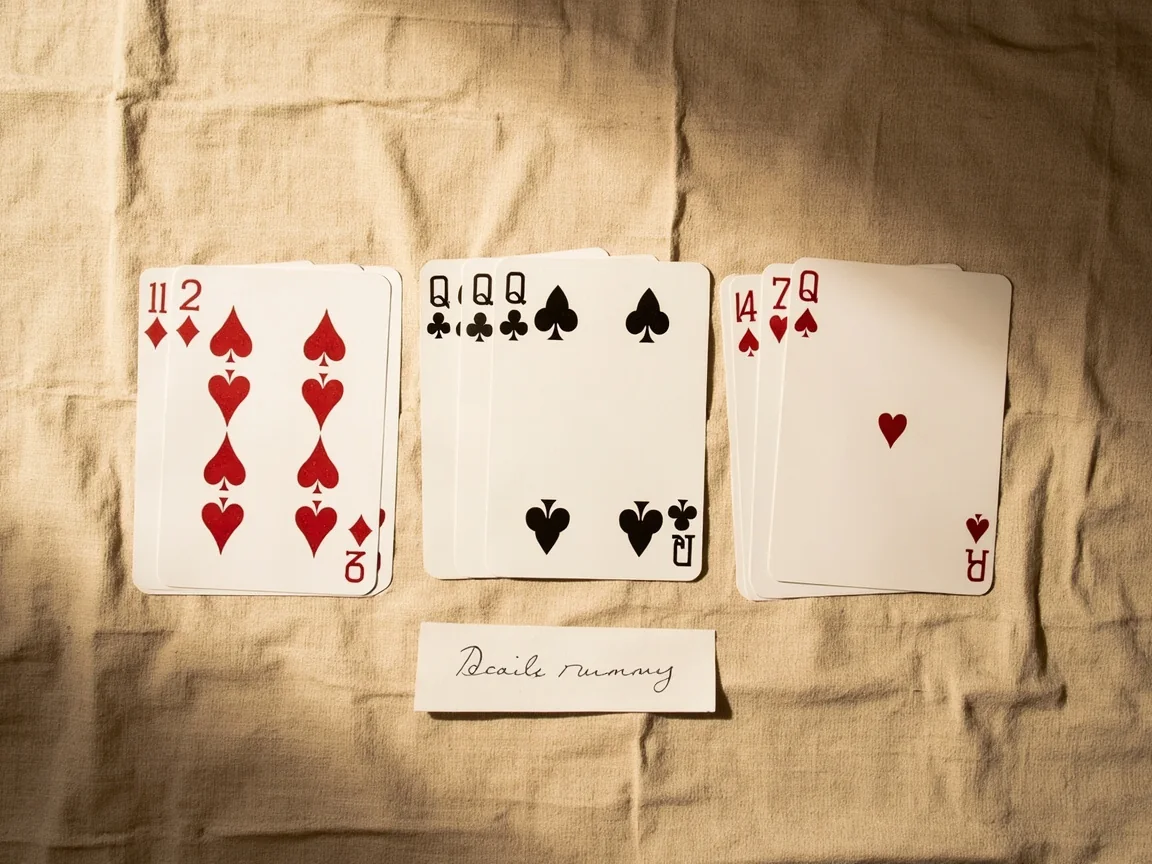
Why deals rummy suits new players
Each deal is a closed loop. The chip settlement is a small, immediate feedback signal. Three deals at a time is a manageable session length, and the chip count is a clearer measure of progress than a single pool-arc score.
Gin rummy
Gin rummy is a 10-card variant. The structure is similar to 13-card rummy, but the hand is smaller, the declaration is a knock rather than a show, and the scoring is to 100 points across multiple hands.
Gin rummy is rarely the headline format on Indian rummy platforms, but it is a useful variant to know. The 10-card structure means hands turn faster, and the knock mechanic creates different end-game dynamics than 13-card rummy.
13-card rummy
13-card rummy is the most common format on Indian rummy platforms. The structure is straightforward: 13 cards are dealt, the player draws one and discards one, and the round ends when a player declares a valid hand.
The 13-card format is where the platform’s house rules are most visible: how many players can join a table, what the minimum stake is, and whether the platform charges a fee on the winner’s winnings.

The standard 13-card format
Two to six players, a standard 52-card deck plus jokers, and a declaration built on at least one pure sequence. The platform’s table unit is the most stable rummy product on the network.
Format comparison at a glance
The format ledger here is the public reference. The house edge on the platform’s rummy tables varies by stake level and by table; the published drop-cost and deadwood values are the same across stakes.
| Decision | Best format | Why |
|---|---|---|
| Five minutes, want a quick round | Points rummy | One tight decision cycle |
| Long, low-stakes jog | Pool rummy (101) | Smaller per-hand swing, longer arc |
| Want to study patterns | Pool rummy (201) | More deals = more signal |
| Learn by repetition | Deals rummy | Three deals = three small hypotheses |
| Want a 10-card variant | Gin rummy | Smaller hand, knock mechanic |
Format questions
What is the difference between points rummy and pool rummy?
Points rummy is a single-deal format where the loser pays the winner their deadwood total. Pool rummy is a multi-deal format where players are eliminated once their cumulative score exceeds the pool limit.
How long does a deals rummy round last?
Three deals are the standard round length for two players. The round closes when both players have played all three deals and the chips are settled.
Can I switch formats mid-session?
Yes — you can leave any table and join a different table. The chip balance carries across tables within the same platform session.
Is the house edge the same on every format?
No. The platform publishes a fee structure per stake level. The fee is the same across formats at the same stake, but the variance per session is different.
The full format desk
The format desk is the platform’s binding source for the format ledger. The desk is staffed by the editorial team; the response time-band is published in the help center. The desk is the binding source for the platform’s format commitments.
The desk publishes the update in the help center; the player should verify the published date before relying on any format.
A closer look at the wild joker
The wild joker is a randomly selected card from the deck after the deal. The wild joker substitutes any card in a set or an impure sequence, but never in a pure sequence. The wild joker is the binding source for the platform’s joker rules.
The wild joker is selected per round, not per hand. The selection is fixed for the rest of the round. The published rules are the binding source.
More format questions
What is the difference between pool rummy 101 and 201?
The pool limit is the difference: 101 points for the beginner pool, 201 points for the advanced pool. The 201 pool has a longer arc and a smaller per-hand swing.
Can I switch formats mid-session?
Yes. You can leave any table and join a different table. The chip balance carries across tables within the same platform session.
The full format desk
The format desk is the platform’s binding source for the format ledger. The desk is staffed by the editorial team; the response time-band is published in the help center. The desk is the binding source for the platform’s format commitments.
The desk publishes the update in the help center; the player should verify the published date before relying on any format.
A closer look at the format variance
The format variance is the binding source for the player’s session strategy. The variance differs across formats: points rummy has high variance per deal, pool rummy has medium variance per deal, deals rummy has low variance per deal. The variance is the binding source for the player’s session strategy.
The format variance is the binding source for the player’s session budget. The player should choose the format that fits the player’s session budget; the choice is the binding source for the player’s strategy.
A closer look at the fee structure
The fee structure is the binding source for the platform’s house edge. The fee is rounded from a small percentage of the winner’s winnings, typically 5 to 10 percent. The fee is the binding source for the platform’s house edge.
The fee structure is the binding source for the player’s long-run expectation. The fee is the structural floor; the right strategy minimises the variance around the fee.
The full format archive
The format archive is the binding source for the platform’s format record. The archive lists the prior format advisories with the publication date and the trigger. The archive is the binding source for the platform’s format record.
The archive is the binding source for the platform’s format commitment. The player should verify the archive; the verification is the binding source for the player’s strategy.
The full format glossary
The format glossary is the binding source for the platform’s format vocabulary. The glossary includes: points, pool, deals, gin, closed pile, open pile, drop, middle drop, full count, invalid declaration. The glossary is the binding source for the platform’s vocabulary.
The glossary is the binding source for the platform’s format commitment. The player should verify the glossary; the verification is the binding source for the player’s vocabulary.
A closer look at the choice between formats
The choice between formats is a session-by-session decision. The format ledger on this page is the public reference; the right format is the one that fits the session the player has. A short session calls for points rummy; a long session calls for pool rummy; a study session calls for deals rummy.
The format also affects the platform’s fee structure. The fee is the same across formats at the same stake level; the variance per session is different. A long format has lower variance per deal but a longer arc; a short format has higher variance per deal but a shorter arc.
The house edge in plain English
The platform’s fee structure is the house edge. The fee is rounded from a small percentage of the winner’s winnings, typically 5 to 10 percent. The fee is the same regardless of the format; the variance per session is different.
The house edge is the structural floor. No strategy can remove the house edge; the right strategy minimises the variance around the house edge. The strategy desk is the binding source for the math-bounded reads.
The format archive
The format archive is the historical record of the platform’s supported formats. The archive lists each format with its support date, deprecation date, and version notes. The archive is the binding source for the historical record.