How to play rummy on melbet

What you need to play
Indian rummy is played with a standard 52-card deck plus two jokers (printed and wild). The platform deals 13 cards to each player at two to six tables. The goal is to form valid melds and declare first.
| Item | What it is |
|---|---|
| Standard deck | 52 cards in 4 suits, 13 ranks (Ace to King) |
| Printed joker | Two jokers included in the deck; they replace any card |
| Wild joker | One card is randomly selected after the deal; it substitutes any card |
| Players | 2 to 6 per table |
| Hand size | 13 cards each |
The turn order
Each turn has two mandatory steps: draw and discard. The draw is either from the closed deck (face-down pile) or from the open discard pile (face-up pile). The discard is placed face-up on the open pile.
- The player draws one card from the closed deck or the open discard pile.
- The player may form melds and arrange the hand.
- The player must discard one card face-up on the open pile.
- The next player begins their turn.

The first deal
The first deal sets the wild joker. From that moment, the wild joker is fixed for the rest of the round. Players may use it as a substitute for any card in a set or impure sequence.
Meld rules
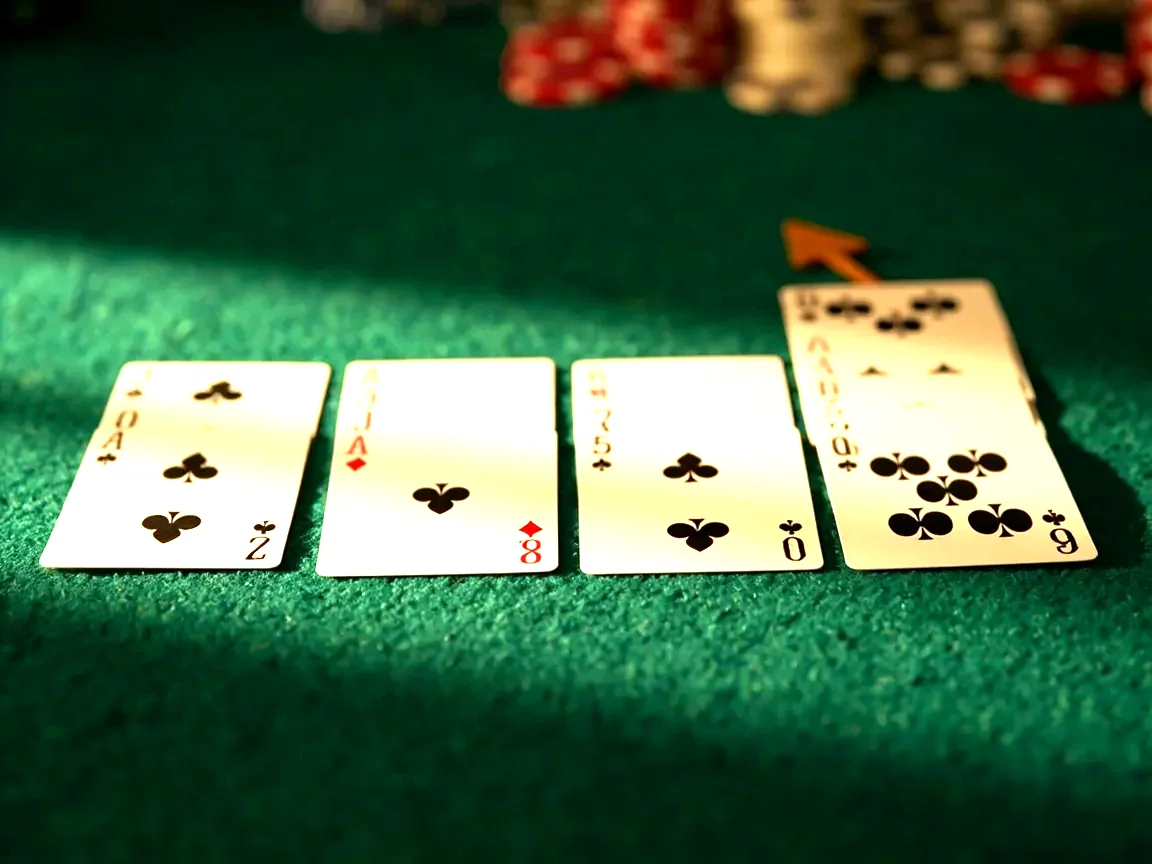
A valid declaration has at least one pure sequence, plus a second sequence or sets that cover all 13 cards. The two pieces are: a pure sequence (three or more consecutive cards of the same suit, no jokers), and other sequences or sets.
| Meld type | Definition | Example |
|---|---|---|
| Pure sequence | 3+ consecutive cards, same suit, no jokers | 5♠ 6♠ 7♠ |
| Impure sequence | 3+ consecutive cards, same suit, with joker | 5♠ Joker 7♠ |
| Set | 3 or 4 cards of the same rank, different suits | 9♠ 9♥ 9♣ |
| Invalid declaration | No pure sequence, or a card not in any meld | — |
Two sequences is the floor
A valid declaration needs at least two sequences — one pure, one impure or pure. Sets alone do not satisfy the floor. Any card not in a meld is deadwood and counts against the player.
Drop, full count, and invalid declaration
The three ways to end a hand without declaring are: drop, full count, and invalid declaration. Each has a different cost and a different signal.
| Outcome | Cost | When |
|---|---|---|
| First drop | 25 points | Player drops before drawing the 4th card |
| Middle drop | 50 points | Player drops after drawing at least one card |
| Full count | 80 points | All 13 cards ungrouped at the end of the round |
| Invalid declaration | 80 points + zero winnings | Declared hand is not a valid meld set |
Reading the discard pile
Picking from the discard pile is a public signal. It tells the table what you are missing. Reserve the open pile for cards that close a sequence in one move. Avoid breaking your own meld structure for a single short-term gain.

The discard decision
Hold the card you can least afford to lose. Discard the card that does not fit any sequence and does not close a set. If neither answer is clear, a middle drop is cheaper than a full count.
Beginner questions
What is a pure sequence?
A pure sequence is a run of three or more consecutive cards of the same suit with no jokers. It is the floor for a valid declaration.
Can I declare without a pure sequence?
No. A pure sequence is mandatory. Without one, the hand is invalid regardless of the rest of the structure.
What is the difference between a printed joker and a wild joker?
Printed jokers are the two jokers included in the deck. The wild joker is a randomly selected card from the deck after the deal — it substitutes any card.
How do I count deadwood?
Deadwood is the sum of unmatched cards. Numbered cards count at face value, face cards and aces count as 10 each, jokers count as 0.
The full beginner desk
The beginner desk is the platform’s binding source for the rules. The desk is staffed by the editorial team; the response time-band is published in the help center. The desk is the binding source for the platform’s rules commitments.
The desk publishes the update in the help center; the player should verify the published date before relying on any rule.
A closer look at the joker rules
Printed jokers are the two jokers included in the deck. The wild joker is a randomly selected card from the deck after the deal. The wild joker substitutes any card in a set or an impure sequence, but never in a pure sequence.
The joker rules are the binding source for the platform’s meld rules. The rules are published in the help center; the player should verify the rules before declaring.
More beginner questions
Can I declare with a joker-only sequence?
No. A pure sequence is mandatory. Without one, the hand is invalid regardless of the rest of the structure.
What happens if the wild joker is in the closed pile?
The wild joker is randomly selected from the deck after the deal. If the wild joker is in the closed pile, the player who draws it first uses it as the substitute. The selection is fixed for the rest of the round.
The full beginner desk
The beginner desk is the platform’s binding source for the rules. The desk is staffed by the editorial team; the response time-band is published in the help center. The desk is the binding source for the platform’s rules commitments.
The desk publishes the update in the help center; the player should verify the published date before relying on any rule.
A closer look at the discard pile
The discard pile is a public signal. The card the player picks from the discard pile is the most useful signal because it tells the table what the player is missing. The discard pile is the binding source for the table’s read.
Reading the discard pile is a slow skill. The player should track which cards have been discarded, which suits are flowing, and which opponents picked up from the discard pile. The chat is rarely informative.
A closer look at the closed pile
The closed pile is the bound source of the remaining cards. The closed pile is the binding source for the math-bounded reads. The player should pick from the closed pile when the player needs a fresh card.
Reading the closed pile is a slow skill. The player should track which cards have been discarded, which cards are still in the closed pile, and which opponents’ melds are absorbing. The closed pile is the binding source for the long-run expectation.
The full beginner archive
The beginner archive is the binding source for the platform’s rules record. The archive lists the prior rules advisories with the publication date and the trigger. The archive is the binding source for the platform’s rules record.
The archive is the binding source for the platform’s rules commitment. The player should verify the archive; the verification is the binding source for the player’s compliance.
The full glossary
The glossary is the binding source for the platform’s rules vocabulary. The glossary includes: meld, deadwood, declaration, drop, middle drop, full count, invalid declaration, pure sequence, impure sequence, set, wild joker, printed joker. The glossary is the binding source for the platform’s vocabulary.
The glossary is the binding source for the platform’s rules commitment. The player should verify the glossary; the verification is the binding source for the player’s vocabulary.
A second walkthrough of the first hand
The first hand is the most important hand of the session. The first hand sets the tone for the table, the discipline of the play, and the risk appetite for the session. A relaxed first hand is a useful investment; a tense first hand is a warning sign.
Three habits for the first hand: (1) sort the hand in the first five seconds; (2) finish a pure sequence in the first three turns; (3) drop early if the hand has no path to a clean declaration. Each habit is a small judgment, not a rule.
A closer look at the meld structure
The 13-card hand has 4 possible structures: (1) two pure sequences plus sets; (2) one pure sequence plus one impure sequence plus sets; (3) one pure sequence plus sets; (4) one pure sequence plus a long set. Structure (3) is the minimum for a valid declaration; structures (1) and (2) are the safer bet.
The structure is built turn-by-turn. The first turn should aim for a pure sequence. The second turn should aim for a second sequence or a set. The third turn should aim for the second sequence. The fourth turn is the drop decision point.
The declaration step
The declaration step has three parts: (1) place the 14th card face-down on the discard pile; (2) lay the 13 cards out in the meld structure; (3) press the declare button. The platform verifies the meld structure automatically; if the structure is invalid, the platform charges the invalid-declaration cost (80) and zero winnings.
Verify the meld structure before pressing declare. The most common mistake is a card that is not in any meld; the second most common is a sequence that is not actually a sequence (a hidden joker substitution).